Planning for the End of SAP PI/PO
Organizations running SAP Process Integration (PI) or Process Orchestration (PO) are already thinking about what comes next. SAP has made its direction clear: PI/PO is approaching end of life, and SAP Integration Suite is the long-term platform for integration moving forward.
For many teams, the question is less about whether to migrate and more about how to approach it in a way that minimizes disruption and supports long-term architecture goals, and who you trust to get you there.
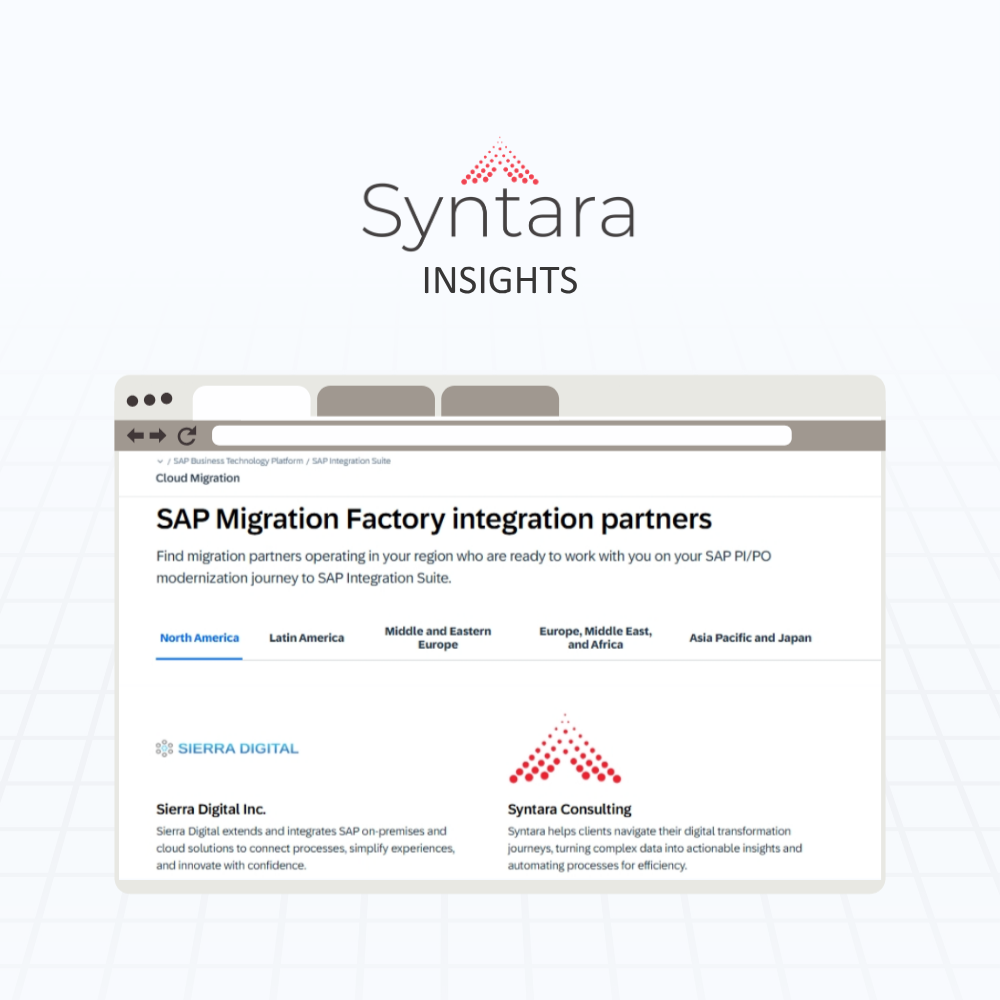
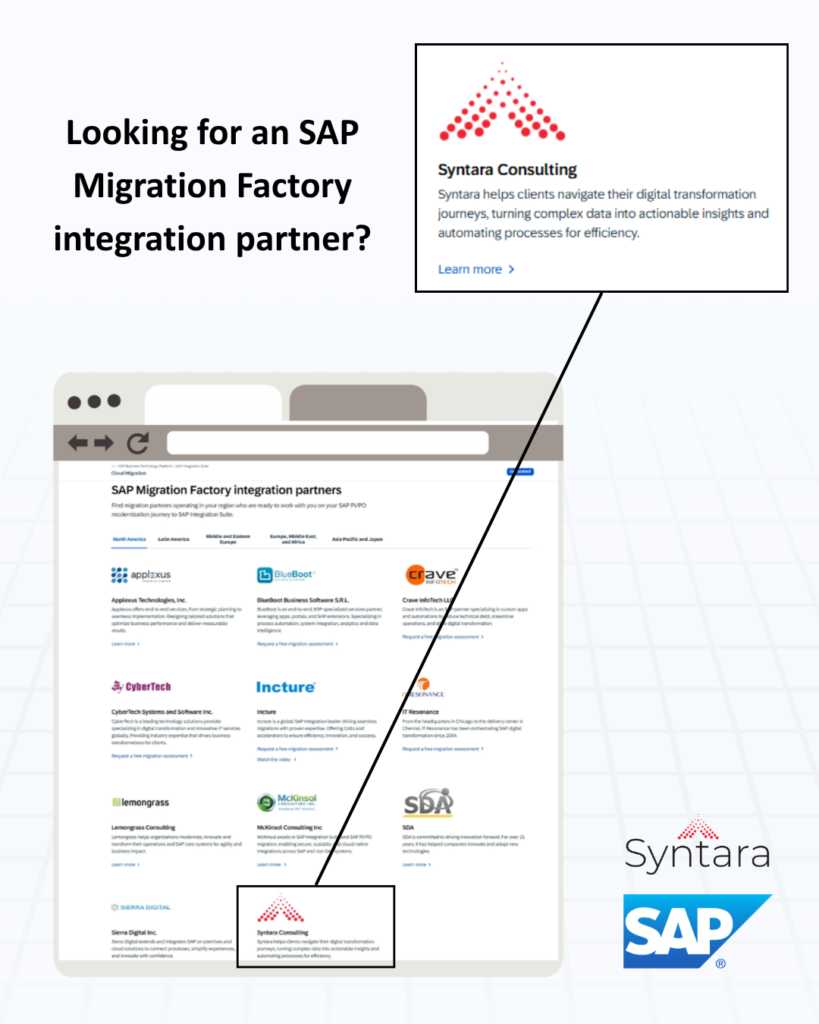
That’s why we’re proud to share a significant milestone: Syntara has been recognized by SAP as an SAP Migration Factory Integration Partner — one of a select group of partners that SAP highlights on its website as customers plan and execute their PI/PO migration strategies.
What It Means to Be an SAP Migration Factory Integration Partner
SAP’s Migration Factory program is designed to support customers moving from PI/PO to SAP Integration Suite. Within that program, SAP highlights partners that have demonstrated a clear approach to migration planning and delivery.
Being included signals that Syntara has:
- Deep experience across diverse PI/PO landscapes and integration scenarios
- A defined, repeatable methodology for assessing and executing migrations
- A track record of helping customers move to SAP Integration Suite — on time and without disruption
Understanding the Shift to SAP Integration Suite
SAP Integration Suite isn’t just a like-for-like replacement for PI/PO. It’s a fundamentally more capable platform: cloud-native, continuously updated, and built to connect SAP and non-SAP systems across hybrid and multi-cloud landscapes.
Key advantages of migrating to SAP Integration Suite include:
- Lower total cost of ownership — no more on-premise infrastructure to maintain
- Faster time-to-value — pre-built integration content and accelerators reduce build time
- Future-proof architecture — built on SAP BTP, designed to scale with your digital transformation
- Continuous innovation — new capabilities delivered without disruptive upgrade cycles
- End-to-end visibility — built-in monitoring and analytics across all integrations
Waiting until PI/PO end-of-life deadlines force your hand isn’t a strategy — it’s a risk. Organizations that start their assessment now have the runway to migrate on their own terms, with minimal disruption to operations.
The Syntara Approach: Migration without the Chaos
Syntara brings a structured, proven methodology to every PI/PO migration — one designed to protect what’s working while modernizing what needs to change.
Our approach includes:
- Comprehensive interface discovery and inventory — we document every integration scenario in your landscape, not just the ones you know about
- Business-impact assessment — we prioritize migrations based on business criticality, not just technical complexity
- Automated conversion accelerators — we leverage tooling to reduce manual rework and accelerate delivery
- Hybrid transition support — we keep your PI/PO environment stable while Integration Suite ramps up, so there’s no cliff edge
- Post-migration optimization — we don’t disappear at go-live; we help you operate and evolve on the new platform
The result: a migration that feels managed, not chaotic — and a team that understands both the technical landscape and the business stakes.
Getting Started with a Migration Assessment
For teams early in the process, a migration assessment is often the most useful first step. It provides a grounded view of:
- The current PI/PO landscape
- Integration complexity and dependencies
- Migration options and sequencing
- Estimated effort and risk areas
Ready to Understand Your Migration Path?
Don’t wait for PI/PO end-of-life deadlines to force your hand. Get started with a complimentary migration assessment — we’ll map your current integration landscape, identify your migration path, and help you understand what it will take to move to SAP Integration Suite on your timeline, not SAP’s.
Contact Syntara today to schedule your free migration assessment and see why SAP put us on the short list.
Common Questions about SAP PI/PO Migration and SAP Integration Suite
What is SAP PI/PO migration?
SAP PI/PO migration is the process of moving integrations from SAP Process Integration or SAP Process Orchestration to a newer integration platform, typically SAP Integration Suite. It usually involves assessing existing interfaces, identifying dependencies, prioritizing business-critical integrations, and planning a phased transition.
Why are organizations moving from SAP PI/PO to SAP Integration Suite?
Many organizations are using the migration as an opportunity to modernize how they connect SAP and non-SAP systems. Instead of simply replacing one platform with another, the move can support a more flexible integration strategy, better visibility, and a cloud-based foundation for future architecture decisions.
Is SAP Integration Suite only for SAP-to-SAP integrations?
No. SAP Integration Suite is commonly used to connect both SAP and non-SAP systems. For many organizations, that matters because real-world integration landscapes usually span ERP, CRM, data platforms, third-party applications, and custom business systems.
How do I know if my SAP PI/PO environment is complex?
A PI/PO landscape is usually more complex than it first appears when it includes a high number of interfaces, custom mappings, undocumented dependencies, business-critical processes, or multiple systems that rely on shared integration logic. That is one reason an upfront assessment is so important.
What should a PI/PO migration assessment include?
A strong migration assessment should document your current interfaces, identify technical and business dependencies, evaluate complexity, highlight potential risks, and prioritize what should move first. It should also help define whether a phased, hybrid, or accelerated migration approach makes the most sense for your environment.
Can SAP PI/PO and SAP Integration Suite run in parallel during migration?
In many cases, yes. A phased transition can help reduce disruption by allowing organizations to keep critical integrations stable while new integrations are built, tested, and validated in SAP Integration Suite. This is often a practical way to avoid trying to move everything at once.
How long does an SAP PI/PO migration take?
There is no one-size-fits-all timeline. The effort usually depends on the number of interfaces, the amount of custom logic, testing requirements, governance needs, and how well the current environment is documented. For most organizations, the first step is not estimating a date. It is understanding the scope.
Why work with an SAP Migration Factory Integration Partner?
For many customers, a recognized migration partner can bring a more structured approach to planning, dependency analysis, prioritization, and execution. That can be especially helpful when your team needs to balance modernization goals with day-to-day operational continuity. As a recognized Migration Factory partner, Syntara brings exactly this kind of structured approach — along with SAP’s endorsement to back it up.
When should you start planning an SAP PI/PO migration?
The best time to start is before a deadline forces a reactive decision. Early planning gives your team time to assess the current landscape, align migration work to business priorities, and make architecture decisions with less pressure and less disruption.
What is the first step if we are just starting to evaluate our options?
A migration assessment is usually the most practical starting point. It helps create a clear inventory of your current integration landscape and gives your team a more grounded view of priorities, effort, and next-step options.